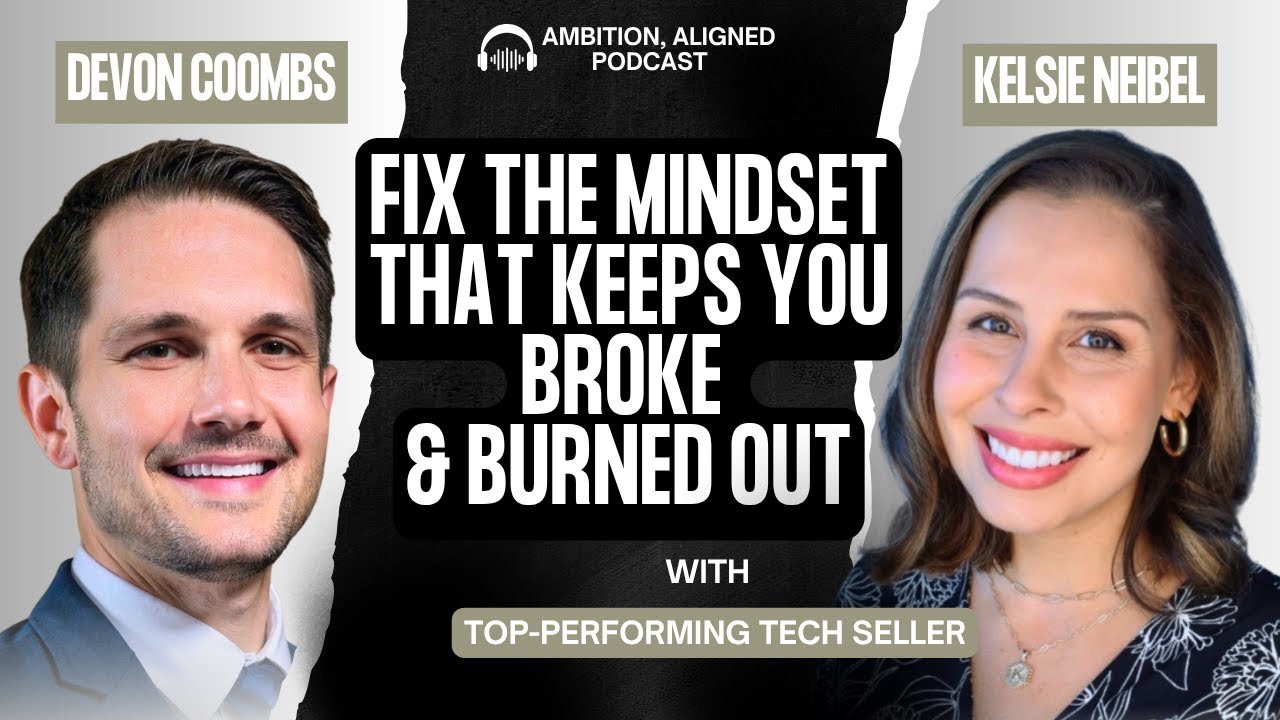
Episode 18 · 33 min · July 8, 2025
Your Mindset Is Keeping You Broke and Burnt Out. Here Is How to Fix It.
With Kelsie Neibel, Technology sales leader, formerly with Deloitte and Goldman Sachs
Watch here or open on YouTube. Captions and playback speed are available in the player.
Read or search the transcript
YouTube auto-generated captions. Transcription errors may remain, especially in names, numbers, and technical terms. Check the video before quoting. Select a timestamp to play that moment.
64 timestamped passages · Download transcript (.txt)
95 to 98% of your success is driven by the way you think. You could actually practice the thoughts that you're going to think and they could be positive. Money was my master. It controlled everything I did. It was my gatekeeper. They're multi-millionaires. Everything's going for them. All graduated from the best schools, have ideal lives, and great jobs that actually aren't putting a lot of pressure on them, but their mindset is so off because it's all like the toxicity of the culture. Money is my servant is now my new tagline and money is an enabler and an amplifier to what I
want to do and it's going to easily find me and it's always going to be there for me. Hey everyone, how's it going? Welcome to Ambition Aligned. Today's guest is my friend Kelsey, a top performing tech seller with experience at great firms like Deote, Goldman Sachs, and high growth startups. After hitting burnout, she rewired not just her schedule, but her whole mindset. Now, she helps other high achievers do the same. If you ever find yourself tied to the value of your work or wonder how to thrive without burning out, this episode's for you. Let's dive in.
You are both a very high functioning, highintensity professional working jobs from Deote Consulting, Goldman Sachs, and now tech sales. But you're also prioritize your family and you have this brand a really brand and a lot of u written materials around how you can do both and I'd love to pick your brain on how are you finding the balance so many people right now are struggling with work life balance especially in Silicon Valley it's been really really tough on
a lot of people as companies make cuts and return to office and all of that what what's your secret what are you what are you doing different than everyone else yeah I mean it's a it's a million-dollar question right Devin Um, but I mean I think like like you mentioned, we're in this really interesting phase of I think history where we're at this inflection point where everyone is feeling this like overwhelming uh performance burnout. At least that's what coming from my background of like always working at these massive corporations, have always been a high
achieving professional. Um, and kind of the output has been like a lot of pressure to be able to perform under that. And so I think we're at this interesting inflection point of like we've got a lot of talent in the market that is struggling to figure out how it's going to be sustainable especially as they go into things like parenthood or balancing family um and also just like still achieving but not feeling like they are going underwater. Um personally for me Devon like that has been a story I've experienced. I
experienced burnout uh early on in my career, several times throughout uh my time in consulting as well and even in tech sales. There's a lot of uh pressure from burnout. And I think that what's shifted everything for me, if I can boil it down to like one main thing, the thing that has shifted me out of that like burnout, how am I managing all of this to like a more balanced fulfilling career and lifestyle has been changing how I think. Um, I'm in tech sales now
and I, uh, I have a saying that the hardest territory that anyone ever has to manage now is the the two between your ears, which is your brain, right? So, um, that's really what started to shift everything for me is how I started to think about my reality, my goals, my dreams, and that has actually lended itself to really healthy balance um, in terms of what I'm able to work and achieve. So, it's been it's been everything, but it's been up here as well. Okay, I pause you there for a second because I think that's always an
interesting challenge to me because so many people think reactively, right? Like, yes. I I know a lot of people are like, you can't control your thoughts. They're just things that pop up, right? And so, what do you how do you do that? What do you what do you even talk like? How do you go and actually change that inner dialogue or what are some secrets you have there? Because that I agree. I agree. And that's what the best athletes in the world all say is they have like their inner game, their inner talk and that positivity. But it is how can we do that? How how do you apply that? Yeah.
Yeah. I mean it's such a great question because it really is like a rewiring effort of sorts, right? So like and it all goes back to how everyone's like like you said, right? Like it's just how I think. This is how so many people are wired. They think that they were born a certain way. It's just what they saw growing up. It's who they are. And so they assume that the default way that they're thinking is just how they have to live. Right? There was um a time in my life in the last two years where I met a mentor of mine and she she told me
a statistic that said 95 to 98% of your success is driven by the way you think. And I was like no way. Like you know we come from these backgrounds where like it's about the drive, it's about the accomplishment. It's about the strategy, the tactic. like if we can figure that out you will be successful right but when she started to say that so many people aren't aware of the power of their mind that's when things started to shift for me so I do think that um you know today a lot of people aren't even
aware that you can change the way that your brain is wired and it's a process right like there I went through a really long journey on how to kind of evaluate first is like one how are you thinking today like you have to get to know yourself and understand the wiring and the old beliefs that you are operating on. You might not even be consciously aware of them. Most of us are not. And then you have to figure out how you get there. Um so it's a whole process. But I would say that like one if you are looking to figure out like okay this is
interesting tell me more. I would start by like documenting how do you think you think about your sales process today? How do you think about clients that come and work with you? How do you think about like your own success? Is it hard to get? Is it easy for you to stumble into success? Like what is the story and the narrative you've told yourself up to this point? It's very fascinating when you start to think of it from that angle. Yeah, there's a there's a man there's a lot there to unpack and there was a book I read recent a while ago
called like winning the war in your mind. But it is Yeah. So something I'll share if you haven't um but it's such a challenge for all of us. You read it in finance literature about, you know, people who have scarcity mindsets or they spend too much. And it all goes has nothing to do with actually understanding finances. It all goes down to the patterns and the habits that they've developed. And so I guess I want to go into the science of all that, but how do how do you go from doing high tech to like what's the moment? How what
how do you go from doing high tech to suddenly going into like psychiatry and neuroscience to figure out how to rewire your own brain and start teaching others to do that as well. That's a huge change. Yeah, it is. And it's a huge change. The change really comes from like the purpose behind why I wanted to change. So, I know you're a parent, too, right Devon? Like I became a mom to um I almost have a 2-year-old now. became a became a mom and really what what pushed everyone has like a reason. So people
change for like two reasons usually pain or desire. Uh most people change out of pain. Uh this was actually a moment that was kind of mixed with pain that I knew I was like struggling with burnout and anxiety and um tying my worthiness to my results as a seller. And then when I became a mom, I wanted to shift into this woman that didn't show that showed her a woman that had a career that wasn't like so concerned about where she
stood on the leaderboard or how her results looked like she was a worthy enough human being to be her mom regardless of any of the external factors. So when I wanted to make that change for my daughter first of off and for me second, I said I want to figure out what's going on up here because I had I was aware when I had struggled with burnout at Goldman Sachs early on in my career. I was aware of the fact that like your brain drives everything.
So how you feel drives how you act and how you emotionalize everything else in your world. So when I wanted to make this shift, it was about understanding, okay, how do I go about rewiring the brain? Cuz I too had thought like, well, I come from anx like an anxious family. It's just who I am. I'm just going to be an anxious person forever. And that is just a story. It's just a story that we tell ourselves in the brain through studies of neuroplasticity. You can actually shift the way and build new neuroconivity pathways in your mind. And
everyone used to think that you couldn't do that past like your, you know, your adulthood years. So like once you got into like 25 years of age or or past, it was just hardwired. Good luck change and it's who you were. That is not the case. And studies have shown and there's a huge um emerging market, not emerging market, there goes my tech speak. It's a huge emerging science field that is studying the neuroplasticity of your brain. And so you can actually change the way you feel and operate that deviates from this this old wiring that
you may have been working with for like I don't know years and years of your life. So it really started by like one understanding that this mindset thing it's not woo woo shoo although there is some like there's some woo woo element to it where like you know the power of your mind does shift like what you see in your reality but it's backed by science. This is not like Kelsey just figured out this is some manifestation process. This was like actually backed by the idea that if I was intentional about shifting how I thought, it could
form permanent patterns in my brain and I could actually start to become a totally different woman that has this perfect balance of career and family. How do you do it? I mean, that's all amazing. How do you do it? What? Give me an example. Can you can you walk me through maybe a something you were struggling with? Yes. And then how did you change it? And do you still struggle? Like kind of go walk me through the whole process of what happened, the triggering point, how you fix it. I'm sure everyone would be fascinated. Yeah. Okay. So, let's give
like a really common example that I think more people out here might resonate with this one than we imagine, but let's talk about like a story about money. So, one of the other things I love talking about is money. I know you're, you know, a deal. You you understand the finance element to how we operate, right? When I was before I made this transformation, the way I thought about money was that it was very scarce, hard to get, hard to come by. Uh it could run
away really quickly. And if I didn't have like an enormous amount of savings, like I'd put my entire family at risk, and it was very much like money was my master. If I had a tagline for my relationship with money before this, money was my master. It controlled everything I did. It was my gatekeeper. I did not like that feeling. The feeling of um waiting on some sort of money gift or status symbol before I went and acted out on my dreams of like doing podcasts like this or you know serving serving
other women in this space of like working through tech sales and motherhood. I would give money like a a pretty much it put it on a pedestal, right? So the old thought was money was the master and the new thought. So I always like draw a T-chart. I say here's my old thought and my old beliefs that I maybe was raised with, grew up with, whatever it is. This is the old thought. This made me behave in such ways where it would stop me from following my dreams, stop me from doing the outreach, stop me from creating things that I wanted to talk about. And what is the
new thought? How about we switch it? Usually it's like the opposite of the old beliefs. So like and I'm going to start to see that come through in my reality as well. So I would actually start like mapping out these old thoughts and then the new thoughts I wanted to replace them with and then I would start affirming that like through daily affirmations um through journaling like every single day to try to rewire the brain and and you kind of combine it with the activity of practicing to see it in your reality.
Um, like if you found like if I found a quarter on the sidewalk, I was like, "Oh, see, money easily finds me." And you kind of like have to slowly rewire the brain, but the effort is understanding old, reforming a new thought, and then affirming it, and watching it come into reality more and more. That's kind of the whole premise of it. Yeah, I got to attest to it. something that sounds so strange, but it's I I do it and it's always had the most transformation, like the biggest transformation on my own life is reading out loud affirmations. And it seems
strange and I remember like it will look really weird if you see my in my car before I pick up on a big project. So, I'll read a list of things like I'm here to serve others or changing my mindset that I intentionally and you'll find that it then picks it up. If you practice it a hundred times, then it'll then it'll happen. Your mind will pick it up. It's like practice. Well, you could actually practice the thoughts that you're going to think and they could be positive and like for me one of the big things after I talk to someone I always say like what a great person or like that what a gift and that way it
makes me excited to talk that's changed my way from when I want to approach with people. So um so yeah so that's a really practical tool. How long did it take do for you? How long does it take you or others you think to pick that up? I would say like in this in relative to time, it was very quick. Like I I would say the money the money traumas that I had are virtually resolved now. I still like I'm still a human, but I would say roughly when I started to implement the rewiring process and affirm it and then
keep affirming it and practicing it every day, the whole process probably took less than 6 months. I'd say I got really tangible results in like three months of practicing it. Um, but it it does work. It absolutely works because you subconsciously your brain can't process like more than one thought. So like like how you just said like, "Oh, they're such a great person or they're such a nice person." When you give yourself an affirmation or a phrase to process, it has your subconscious mind can only think in that lens. It cannot.
So that's why words are so incredibly powerful and what you're telling yourself is so incredibly powerful that I started to audit everything I was saying even in my own mind without speaking out loud like I have to you I started to really govern what was coming out of my mouth because I started to see that that would literally reflect in my reality. So if I only hold my team in high in the highest regard, assume they always have the best intentions and assume they're always trying their best.
You just start to see that because that's like how your subconscious is viewing the external world. So it is really a powerful way to start to shift. If you're like experiencing anything in your reality right now where you're like, "This sucks. I don't understand um how this can get better to me for me." Try feeding a different narrative to the story and you'll start to see like that different things start to shift. It's it's it almost feels like magic. It almost feels like magic, but you've experienced it, right? Like it's cool
that someone else is talking about it because it's a weird little It's a niched kind of thing that a a lot I know a lot of people do. a lot of high performers I've met do to optimize their time and optimize their mindset. But it just sounds like if you thought the one doing it, it looks weird and it sounds strange that you have to and the practice is really interesting, right? like you have to at least be self-aware enough to know what you're thinking and a lot of the times that can even look a little crazy like for me for what I found like talking about a for a second
what I found useful for chatbt or other tools like that is just do stream of consciousness or if you don't have that like a coach is way better right of just like here's everything on my mind and then you can start seeing like trends you could be like oh I'm really actually keep being worried about money and then you can make the step of what would I rather Is it a real fear or is it a fake fear? And then how can I change that and then make an affirmation against a fear? But that's that's work. It's a lot of selfwork. You don't like you don't do that randomly overnight and wake up and
suddenly oh I should be saying this instead, right? Yeah. You really have to do the selfwork there. Yeah. You have to do the selfwork and you have to know why, right? Like when you became a dad, there were probably things that like you were like, I got to clean this up or I want to start thinking about this in a different way. Usually it you have to have some some sort of reason that you want to change. I find that is like before doing the affirmations and practicing everything like you got to anchor into your why like why is it meaningful for you to try to shift right
and that's why it comes back to like is it from pain or is it from a desire but either way like your mind is so radically powerful that you can make it but you got to come back to like is it is it meaningful to you? Because if it's meaningful, like it's absolutely possible to to start making those shifts. For sure. Yeah. So, what have you helped other people through this? I know you write about this and you post around it, but what have you seen? Yeah. Like in practice you
building up other people or other I know you've target a lot of moms, especially in sales as a very like what are you seeing people saying or are they actually picking up these practices? what's working for them. Yeah. I mean, it's been um I started going really public with this story of like how this had transformed for me about a year ago and um since then I have had the pleasure of meeting folks like you Devon and like across my entire network as well where other moms or parents um who
have been like I want more time with my family. I also want to hit quota and like just feel secure in my career and as a family man or family woman. Um, how can you help kind of implement some of these mindset shifts? Because the the challenge in the tech sale world, Devon, is that every bit of training is so focused on strategy. It's so focused on tactics. It's so focused on like the how of it. And it's so rarely do we get people talking about the mindset piece.
But like, as you know, it's all it's now what I know is that mindset is really the majority of it. And you've got to get your mind right. So, what I've heard from the community of other sellers and parents who are selling is that they absolutely are struggling with this. It's a it's like you get your worthiness tied up and your quota and your numbers and like are you at the best tech company? If you're not the best tech company, are you even worthy? Are you even good enough? Like they everyone gets wrapped around the axle around all these external factors. And um what
happens is that like when something goes wrong or when you don't have a great year, you find yourself like sometimes in a depressive state like you're actually in depression, you struggle with alcoholism or other kind of like numbing, you know, bad habits that you just like you're not able to cope with. So what's happened is a lot of people have reached out through this story and just said like how can you actually start to shift the mindset so we don't create coping mechanisms, we're actually solving from within. So, it's all been about like what are the affirmations that have you
you've used? How do you use visualization as a tool to like get yourself out of a negative spiral? You know those negative spirals where you're like you're doom spiraling. Like how do you get out of that and shift forward into something that's more productive? And how do you like sustain that practice? So through meditations and affirmations and all of that good stuff is now a part of my practice like weekly. daily. I try to be like daily, but it's a weekly thing now. Um, and so it's been really cool to kind of help
like other people that are in my shoes in the tech sales space to kind of go through that process and see that they're also getting some relief, some relief from like the the burnout and the struggle that a lot of tech sellers experience. So you call it something really something that strikes me is it's really tough especially in the Bay Area but I know in a lot of highly competitive areas that money is such a focus and title is such a focus and you said something very interesting earlier about how you watch what you say and if
I was to infer that I'm guessing you also watch watch what you input because I find I'll do no tech days or or no tech half days. I really try not to use my phone for half a day and my mind will be completely different than if I have my phone because I check my phone. Let's say let's be realistic. Everyone checks their phone every like 10 seconds, right? You're always fiddling with your phone. Um, and I realized like in the culture, especially in competitive tech, tech tech, the competitive tech world, you could be in a really positive environment, but because we're all
talking about numbers and competition and and kind of doomsday. If we don't do this, then we're going to be second best, not first. We're not the number one. People can get really negative and have these I've met people who have crippling addictions, um, alcoholism, divorces, and everything else on like they're multi-millionaires. Everything is going for them, all graduated from the best schools, have ideal lives, and great jobs that actually aren't putting a lot of pressure on them, but their mindset is so off because it's all like the
toxicity of the culture. And so, I don't know, what what's your thoughts there? And how do you rebuff against that? Like you you have to have your mindset while still not getting like fed in by the world throughout the day. It's not the easiest thing, right? Yeah, it's definitely not easy. But that's a pro tip. No tech days for half a day. Is that what you do? You just set your phone aside. Okay. Now I'm going to steal that from you, Devon. Like that. Tell me tell me how it works for you. It's a It's a It's not as easy as you think. Yeah. Yeah. No joke. I'm thinking
like could I step away from my phone for a half day? That feels crazy. Um because it does like I do think you're hitting on a really important point. We are so inundated with a high dopamine hit culture, right? You've got streaming everywhere. Even LinkedIn now is like totally shifting to almost like an Instagram Tik Tok style platform. And as a seller, LinkedIn is one of like my main platforms. I go there to look at account research, people research. Like I use it all the time. And what I had
found before I started making the shift was I would get on to go look at someone, right, to do some research and scroll for 35 minutes just on the feed. Like I wouldn't even be aware of it. And then I'd be like, where did my hour go? So what happens is when you want to shift out and you start to become aware of the power of how you think and what you feed your brain as well is equally important. You start to become very um you do an audit on your life on what you're feeding. So, I've actually I'm off of Instagram. I'm off of Tik Tok.
The only platform I'm on right now is LinkedIn. I create some YouTube videos on the side, but I have almost cut out all the news apps as well on my phone. It's pretty like rigorous, but let me explain why. Let me just give you an example. If you're in a selling role or if you're just like you're about to start your Monday morning, you flip on Wall Street Journal and you see a negative headline, you're immediately going to you'll feel your emotion pull down. You'll see things that just like get you discouraged like pending
recession is coming, right? like market reacts down five points like you know you see that and that is going to carry forward in your day and what I wanted to stop happening was those external things coming into my life and just automatically shifting my energy whereas like I love right now that I sell from a place where I'm like I don't I don't feel impacted by recessions or what's going on in the market I feel like I can make success wherever I them and that my
customers will find me and we will we will solve the problems that they have regardless of the conditions of the market. And that has been so freeing, but I've had to intentionally cut it out because if I kept feeding it to myself, like if we watch the news every night, you're fighting an uphill battle, Devon, you're never going to be able to dis disengage or unplug from it. You have to like like like a virus, you have to like take it out of your life because it can be very negatively toxic. Yeah. And I I see it with teams. I see
it in families. Like if you have one person on a team and or you're especially if you're the leader of a team and you're in that reactive mode and always kind of negative, that's going to permeate across your team. Especially if you are that kind of person who's expecting to ping like a ping at 7 a.m. and 7 p.m. and have an answer right away because you're used to this reactive world. leaders have really got to watch watch out for that kind of activity because it's it's not natural like we need you need your space you and you and it's a misrepresentation that
that's productivity because I know so many I know multi-billionaires who have work in 30 or 40 hour days right like they are highly productive in those 30 or 40 hours and are deep experts in their fields they don't need to be available 100 hours a day and that all of these like Instagram and all these technologies are really capitalizing and get paid by commoditizing our time, right? And so it's a it's a great it's a great feedback and I'm glad you're taking that action. It's not easy, especially when
you're trying to do what you're doing to disengage from the platforms, right? But it's been the most not only like effective shift in my job, Devon, but for my family. Like you're a parent, you guys, you go to the park, right? You see kids parents are just like glued to their phone, right? and they're a kid. Like the most heartbreaking thing is like you can't really blame the human sometimes because they are literally designed like these apps are designed by like the same slot machine gambling companies, right? They're highly addictive and they they hit like you're
releasing dopamine every time you're hitting that. And it's sad. Like it's the if you if you're ever questioning like can I clean up my social media addictions? Like if anything, do it for your kids and your family because it breaks my heart to see parents that are scrolling on their phone at the park and their kids are like, "Hey, mommy, daddy, like look at me." And they can't even pull they can't even pull away from their phone. So like that was one of the things like I did not want my daughter to see me staring at my phone or be on my phone every single hour of the day
because I'm addicted to responding and I'm addicted to a reactive culture. You can get things done in less amount of time if you're rigorously focused and doing the right things. It's not about feeling busy. It's about getting the things done that move the needle to your business or to your job. And then you have to unplug. That's so important. It's all about the longevity of like the health of your family and you as well. Yeah. Yeah. And that's a tough thing to talk to people about because it is an addiction, right? It is. It's a real addiction. And I like Yeah. I know a lot
of people like, "Hey, do you think you use your phone too much?" Like, "Do not talk about my phone." you like I will kill you instead of you know that is a very sensitive and so I wonder um and I find it hard for myself it's something I know and then I'll grapple with it if I have I'll intentionally not take my phone to the park and be worried be like what if something goes wrong nothing's ever gone wrong I've never needed my phone but that it's not a natural state and I I had my phone actually break like a a month or two ago and I'm like what would it be like if I just didn't use it for a week just didn't like the screen
broke but it' still call and it was like my anxiet Y and my health levels instantly improve and so Yes. Yes. Yeah. I I So, how do you incorporate that in your coaching? Like, how do you how could you tell someone that without them getting super defensive? Yeah, I know. It is. It's funny. People like they take it as a personal attack and um and and you just I come from a place where I understand the empathy of it. Like I myself, trust me, we've all doom scrolled. We've all gotten on the phone and been like, "Whoa, where did that two hours go?" Right? Like I I
totally get it. What I would say though is where where I have found a lot of my conversations have gone is not is saying what is it that you're trying to do? So like for example for me I I have worked 50 60 70 hour weeks a lot in my career and I did not do not want to do that anymore. One, I think with like the advances of AI, like I really would be questioning why anyone needs to work like 50hour weeks. I mean, there's so
much efficiency that we're seeing come through with chat GPT and other AI tools. So, like that's a side note. But more importantly, like I try to tell people when they get defensive about like what would happen if you stopped looking at Wall Street Journal every single morning before you started your your work. Um, what could you get in return of that? cuz it's always a trade-off, right? It's an opportunity cost even with your time. So, if you want to sink your time in, I remember when I was on Instagram, I would like get on and I would feel like an anxiety
paying to be like, what am I going to see that could trigger me from my friends or my family or whatever it was? And I just was like, I hate that. I I was almost like feeling sick to get on, but I was addicted to feeling sick about it. And when I finally cut it out, I had so much more time to be present with my kid, present with my husband. I wasn't feeling anxious at the start of my morning. And I got addicted to that feeling more than this like this doom
loop. So it's like, yes, is it hard? And people get defensive. Yes. But and what would it look like if you had that time back? Like you said, your phone broke. What would you do with all that time if you didn't have your phone for a week? Like imagine that. It's fascinating, right? It's like most people can't do it. I haven't been able to go without my phone for a week, but I would be curious to see what would happen if I didn't have a mobile device tied to me for a whole week. Well, yeah, it's a trip to It's just such a trip because, you know, at least drugs, you get something fun
out of it, you know, like at least you're having a good time having a drink or something, you know? But that phone, like you said, like a lot of times I go on, I'm like, "Ah crap, I got to do this this again." Yeah. But you're so addicted. And yeah, maybe that's a good challenge for people is what what would it be like if you just didn't have that because we didn't have it 20 years ago like we we were all not using any of it and quite frankly more present and more available and it's even made like I'm sure you've seen it like networking quite strange like most people have most people use LinkedIn for networking now
like do does someone want to get a cup of coffee people it's tough sales people like you you get that um in person matters still like LinkedIn is great but you still got to show up in % um it does. So what what's next for you then? This is a really interesting cross-section. What are you what are you hoping to accomplish with that's that's why I reached out to you in the first place? You're writing all these great great all this great content really aligning people with their values and rethinking some of the unconscious unhealthy habits we have. What what are you hoping to accomplish from all this?
I mean I think just more more of it, right? Like I think that it's something like you said it's it's out there and some people are like subconsciously aware of what they're doing with their mind or aware of these habits that might be siphoning off precious time with their kids or their family. But I don't think it's talked about enough. So I feel like my life's mission is to to continue to elevate this conversation and help people understand that there is a different way that you get to work and you get to think. It's not something
that your parents gave to you and you're stuck with forever. You can change who you are, how you think, how you operate. Um, the power is in your hands. And I'm passionate about continuing to talk about that. Um, and continuing to be a top-notch seller um, in the tech space. Like, that's still what I love to do. I still love helping customers solve challenges and in the digital modernization space. So, like that's what I like to do, but I love talking about this mindset stuff. Everyone, unfortunately, we had technological
difficulties here, so we had to cut the episode out early. I still want to thank Kelsey for the incredible conversation, and I still hope you found this episode extremely valuable, for your way of thinking about your mindset around work, parenthood, and if you found it valuable, please do me a favor and share it with someone. And uh if well, maybe we'll bring it back on. Um, have a great day. Thanks. Bye.
The conversation
Kelsie Neibel hit severe burnout more than once in a high-performing sales career that ran through Deloitte and Goldman Sachs. She explains the science-backed methods she used to rewire her thinking, the T-chart method for replacing a scarcity mindset, and how she changed her relationship with money.

Devon Coombs, CPA, MBAAssistant Teaching Professor of Finance and Faculty Director of Real Estate Finance, Santa Clara University
Hosted independently by Devon Coombs. Guest views are their own; roles are described as of the recording.
What you’ll explore
- Why mindset, not strategy, sets the ceiling on success
- How neuroplasticity lets you build new thought patterns at any age
- The T-chart method for replacing a scarcity mindset
- Turning money from a source of anxiety into a tool
- Protecting your focus from toxic environments and doom-scrolling
- Why high performers are often the most susceptible to self-doubt
Mindset · Burnout · Money
Share this episode & guest kit
Your Mindset Is Keeping You Broke and Burnt Out. Here Is How to Fix It., with Devon Coombs on Ambition, Aligned. Watch the conversation: https://www.devoncoombs.com/podcast/kelsie-neibel-mindset-broke-and-burnt-out