Episode 20 · 38 min · August 12, 2025
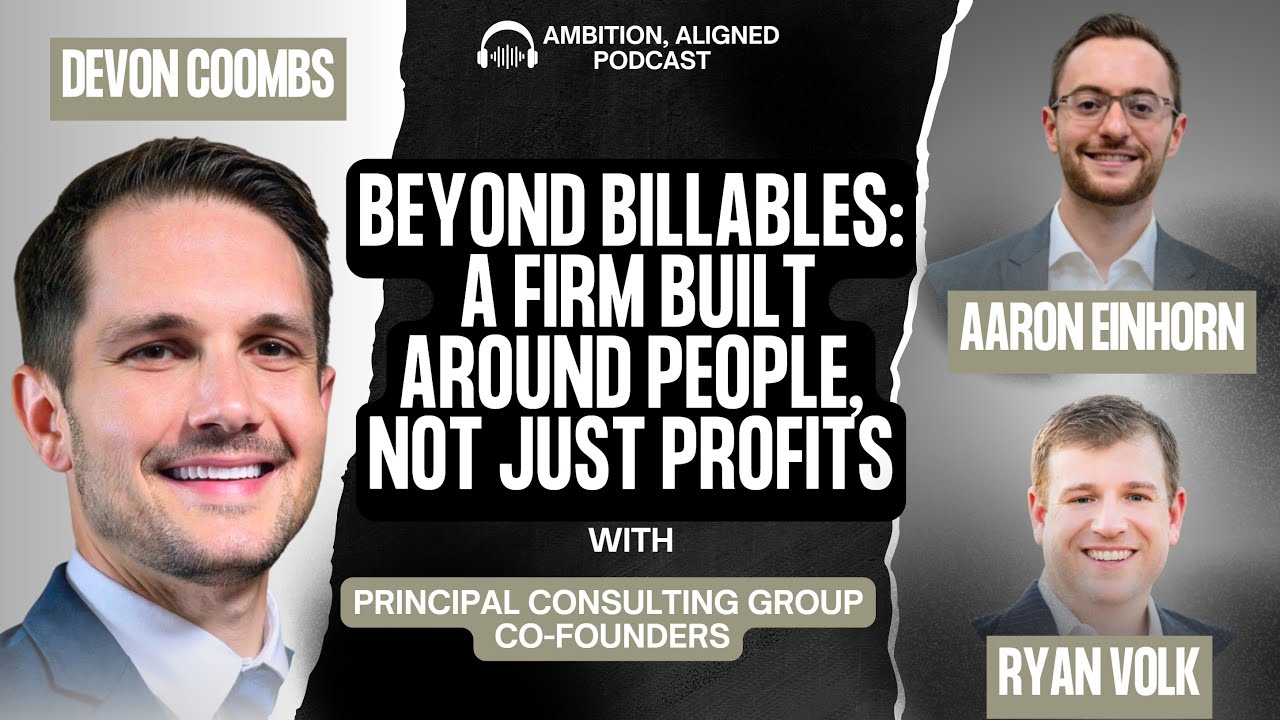
Beyond Billables: How Principal Consulting Group Built a Firm Around People
With Ryan Volk and Aaron Einhorn, Co-founders of Principal Consulting Group
Watch here or open on YouTube. Captions and playback speed are available in the player.
Read or search the transcript
YouTube auto-generated captions. Transcription errors may remain, especially in names, numbers, and technical terms. Check the video before quoting. Select a timestamp to play that moment.
74 timestamped passages · Download transcript (.txt)
It didn't start out as just building a business. We're building a place where great people could do great work and enjoy doing it. >> Hire slow, find the right people. If there needs to be changes, you make it fast, which is not easy and takes a lot of leadership. >> When we first starting, it was successful to me just to get our own project and not be with someone else. Clients weren't just coming to us for extra hands, like actual strategic guidance. >> Hi everyone. On this episode of Ambition Aligned, Ryan and Aaron, my good friends
and co-founders of Principal Consulting Group, share how they built a firm around people, not just profits. From late night talks to leading a fast growing advisoring firm, if you care about building a team the right way, this one's worth your time. Hey guys, thanks so much for coming today. I would love for everyone to get to know you all a little better. >> We'll start with a few introductions about ourselves. Hey everyone, I'm In. I'm one of the co-founders of Principal Consulting Group. Quick background started my career in audit at Deote in
San Jose transitioned into accounting reported advisory eventually met Ryan and co-ounded PCG before PCG I started my career in public accounting KPMG provided a great foundation working with large complex clients across a lot of different industries after that I moved into an industry role where I worked closely with kind of the day-to-day operations s financial reporting strategic initiatives. After that went back into consulting
where me and Aaron met and decided after many late night conversations to start PCG together. And I think that that experience across the big firm, the small firm, the industry has really shaped a lot of what we're doing today at BCG. I think everyone would love to learn more about what were those late night conversations and how did you all decide to go stick it out on your own. I think that's fascinating. >> Yeah, we met while working together at a prior firm as I mentioned. What stood
out immediately to me was how aligned we were. I think that still is true today but not just in terms of work ethic but in how we thought about client service problem solving kind of team culture. Over time, we kept circling back to the same idea and I think we said why don't we try and build something more agile, more collaborative. Eventually, the timing was just right and we decided to take the leap. It didn't start out as just building a business. We were
building a place where great people could do great work and enjoy doing it. >> Just to tack on to that, I think the heart of it was we really enjoy working together. And I remember at first we were talking about, hey, we'll go to another firm together as like a package deal, take both of us or neither of us. But the more we thought about it, the vision was to create a place that would attract the
type of people we want to work with. You know, >> it's great that you started around a vision. I so many businesses don't. They're just looking to make some money. And interesting thing about the accounting profession is you guys were already making money, right? And so doing something like this was more of a passion or leaning into a valuesbased system, which is really cool. But I'm curious, what did that first 6 months look like? That's a huge change to go from making salary and just billing hours and hoping to get your bonus to going out doing your own thing. What was that first 6 months like?
>> I think that first 6 months was a mix of excitement, uncertainty, a lot of problem solving, a lot of late nights. We were wearing every hat, selling work, delivering it, building the brand, setting up infrastructure, just setting things out the way we want. It was also that first 6 months that we were fortunate to land great clients early on, but that also meant we had to scale up quickly and make decisions fast. I think we hired our first employee within the first 6
months. One of the biggest early lessons was that relationships matter more than anything. The trust we had built over the years opened doors and delivering quality from day one continued to keep those doors open. Um, so I think we we kind of leaned into what made us different being nimble, the drive to do good work, figure things out and problem solve and the collaboration we had. >> Yeah. I just thinking back to the first 6 months, a lot of lessons,
a lot of mistakes, but I think we've slowly learned from them, improved over time for sure. Remember our first pitch didn't go very well, and then we stumbled across our old PowerPoint that we used. >> Well, what I'm hearing there is you guys had a bias for action, though, right? You went all in, even if you didn't have all your ducks in a row. You got to figure out your timing and you led with, hey, you had a good idea and you cared about the people and doing a good job. The rest will figure itself out and a bit of it did with the hard work put
behind it. It sounds like, right? >> Yep. Definitely. >> When did you guys know that it was going to be successful? Like in that first 6 months, was there a moment where you guys were like, "Hey, >> our definition of success has continually evolved since we started." When we first started, it was successful to me just to get our own project and not be working for someone else, even if we never ended up hiring anyone. And I can still remember starting and in
imagining, wow, what would it be like to have a five or six person firm? I can't even imagine. And I remember thinking on every point along the way once we got to 60 people, wow, I can't imagine what it'd be like to have a 15 or 20 person firm. It really was a dream more than like a concrete goal. As as we continue to grow and build and be successful, it's
definitely given me more courage to dream bigger and have more faith that we're capable of achieving those goals and dreams. When we started out, it's like, hey, if we find our own client, great. Anything else is great. Yeah, I think the moment I wouldn't say we realized it was going to work in the first 6 months. probably didn't realize it in the first year, but thinking back, it was probably a year and a half in where there was a moment we were working on multiple projects
with some large clients. Had this realization that we weren't just getting work, clients weren't just coming to us for extra hands, but actual strategic guidance. They trusted us to solve some of their most complex problems, and they're referring us to others. I think that was kind of the the point where I was like, man, we've we've got something here. It was clear we were building something that had value. >> Did the vision change at all throughout the last 5 years? Went through those different stages of employees and
building something here or has it stayed, okay, doing good work with good people and prioritizing relationships? >> Yeah, I'd say yes and no. Our core values, I don't think they've changed and I hope they never do. Um but our visions for you know the future. Yeah. I think we were initially very lean, hands-on, scrappy. It was us and a couple trusted colleagues, clear mission to deliver the quality. I'd be the kind
of partners we always wished we had. Those are still some of the clear mission we have. I guess as we grew, the scale and vision has grown as well. We've expanded our capabilities not in just technical accounting but beyond it including data analytics systems process automation and we've built a team of incredible professionals that have matured into a fullervice advisory firm which I don't think we initially had that vision but as Aaron said what
hasn't changed is the mindset you know everyone kind of still acts like owners stay close to the work put relationships and quality first >> I mean that's it's It's fascinating that I've met so many entrepreneurs who define their core values after starting the business and years that stay true. What would you say were some challenges or ways that you're approaching keeping that quality and that culture while you scale? >> Cuz I know it's a big challenge for a lot of people like it's easy when you're a small group of people to all have the same vision and as you grow out it's
challenging to keep the same quality. How are you navigating all that as a team? >> 100%. I think it's been one of the biggest challenges and it meant investing heavily in really hiring the right people. People who not only had a strong technical background but also aligned very much with our values and our approach. I think we also focused on building repeatable processes so the teams could deliver consistently
without trying to reinvent the wheel every time. I think as I mentioned earlier, we still stay very close to the work. It's not about choosing between quality and scale. If it's designed correctly within the firm, we don't have to focus on the people and the culture. So, >> something I've seen being with you guys is how good the culture is and how much you focus on hiring the right people and making sure there's that fit. You hire slow, find the right people, and if there needs to be changes, you make it fast, which is not easy and takes a lot
of leadership. Has there been any times that had major inflection points where you noticed that the firm kind of took off positively or negatively? And how have you navigated that through these seasons? >> I can say off the top of my head there are a few. I think one of the biggest was landing a major client that trusted us with a high visible high stakes engagement that put us on the map kind of validated our approach. Another was when we really started investing in the automation and analytics capabilities
that opened the door to bigger more strategic projects and really set us apart from some of the other firms out there. We've also had our challenges. Those are two good inflection points. I think some of the tough one was when we grew faster than we were really operationally ready for. It made us take a step back and build that more scalable infrastructure. It was definitely painful at the time, but it made us more mature and resilient going forward. There's been a lot of inflection points,
good or bad, and each one has pushed us to grow in ways we couldn't have or wouldn't have planned for, but it's part of what makes the journey so rewarding. >> Yeah. And you guys navigated such a complex the last 5 years have not been the most stable from an economic perspective to what we went through co and then all the election cycle. It's been an early that's strength resilience strength for a company. >> It is. You talked about the team earlier
and what we built at this point and everyone's like man there's so much M&A activity in in the space. Why don't you guys sell it? You could probably do this again in a few years. It's like, no, I don't know if we could build what we've done today and get the collection of people that we have today. It is pretty cool. >> Was there any systems or anything you guys relied on when you're kind of working out the nuts and bolts for the audience? You know, starting your own thing, figuring out things like payroll, closing the books, making sure the lights stay on and make sure you're using the right banking partners and making sure all that takes a lot of
time, right? It takes a lot more while you're trying to still work in your business. You're trying to run your business. was there any advice you have for other entrepreneurs that made it easy or did you have to learn along the way? I mean, fortunately, we're accountants, so we got a leg up on, you know, someone who's used to this stuff starting business. But honestly, I think there's a lot of just cheap accessible small business web- based tools that automate
a lot of the mundane stuff that really helped. So even just the basics like QuickBooks, we use Gusto stuff like that make life a little easier. Yeah, finding those systems for the areas that the accountants don't want to deal with HR, payroll, some of the people side of things. Standardize that made things easier. But a lot of it is going back to building processes and
playbooks and being able to help deliver consistently and let people focus on what they need to be focusing on and not dealing with the HR stuff, the insurance, the benefits, making sure that's all taken care of. >> Yeah, that makes sense. So with that, what's changed in your leadership? I'm curious over the last five years, what has changed for yourselves and how are you intentionally building your culture today?
Thinking back to the inflection points when we started out, it was all about how can you get our next client and execute on the project and throw in, oh crap, we need to go hire someone yesterday because we're, you know, cranking 80our weeks. We definitely hit some inflection points. I remember how weird it felt when we realized we were no longer personally touching every single engagement. Ryan and Honey
were personally overseeing every billable hour. We had our hands on the client work. We could step in and take over that went wrong. Getting to the point where we start losing that visibility was a huge mental shift where we needed to start focusing on developing our team, trusting them to deliver the same level of quality that
we would and as mentioned building those processes that are going to ensure the quality and the relationships and everything that we want to happen is happening. That was a big mental shift and I think we're continually going through that as we grow just the different problems we face along the journey and things we need to learn and and focus on. But that's been an ever growing focus. How do we develop the team and build out these processes
versus doing the day job part? One of the hardest things of being a leader is leading other leaders or developing future leaders, right? And getting out of the business itself and trusting those leaders to run it and being able to take on the risk tolerance of leaders make mistakes. And that's never Yeah. And so it sounds like you build processes around that and that's a big learning, right, of how to trust those people and build the processes around it to enable them to succeed. >> But on the flip side, I'll just add if you hire really good people, it makes it
a lot easier than it would be otherwise. So, what's been your secret there? >> I was going to say, yeah, I think we do have a great team. I think I mean, going back similar to one of the biggest mistakes was just trying to stay too close to everything for too long. I think we thought being hands-on was the best way to protect kind of the quality, but in reality, it created a lot of bottlenecks and slowdowns and slowed down team development. I think it took a while to realize leadership wasn't about doing everything yourself. It's about
others to lead. Once we figured that out and made things better and more scalable, right? >> Yeah. It's fascinating. My time at Google, you saw the difference between a strong leader and a not strong leader wasn't their technical competency. It was do they trust their team? And the people who didn't trust their team would burn themselves out pretty fast cuz they get their finger in every bucket. And when you're managing 100 people, you get in trouble pretty fast doing that. So, you've brought up a few times like, "Hey, hiring great people makes this easier."
But I think everyone would pay you guys just as experts if you could tell everyone how to hire good people because that's not an easy process to vet and sure you got good people then retain them. What's your secret or what do you think has led to your success there? >> Yeah, there's a lot there. You know, part of it almost just goes back to how we started in the values, right? Like I can remember when Ryan and Ed we were at another firm you know we were at one
point we worked you know I talked to over 100 bill hours in a week we were Ubering to and from the client's office it wasn't safe to drive they're trying to flip public just utter chaos love working with Ryan on a single time that I see them treat disrespect or I snap it then or just like create other firms or teams at the instant there's that negative
response frustration it breaks down the team dynamic quickly and you know that that was a big part like why I want to keep working with this guy right and you know there are a lot of lessons I tried to observe and learn from during my time at delaying other firms like what worked well and looked in in terms of keeping people happy and building good
teams. Some of the most successful teams I was on attracted people to them because of the positive environments. They have fun together, you know, they enjoy it was people that you want to be friends with outside of work, right? It really felt like the existing model at big four and a lot of other firms just felt broken in a lot of ways with the bureaucracy, the pay structure,
the amount they were paying. You know, it's gotten a little better since then or even just the growth opportunities. You know, elevate yourself and take on more challenges if you're ready, right? versus a very very strict hierarchical structure. These are some examples, but we really put a lot of into creating an environment that attracts high performers, people that aren't satisfied with the status quo and you're going to leave one of those other
organizations for something better. ing. I want to create a place where they feel like the enchantment is, you know, as good as we can make it for them, right? Whether that's career growth opportunities, flexibility, the comp structure, you know, opportunities to work on the business itself or get into new areas, whatever we can do to create that environment.
And then we kind of make critical mass at a certain point where we have this cool culture in one team and it's cool when people come someone starts and it's just this positive feedback loop where you can feel all the good vibes right and you want to be a part of it. So I don't know if that's a very scientific answer. >> So what I'm hearing from you is that you screen for people that are positive and encouraging. It sounds like future
leaders. You're screening for people rather than just finding headcount. You're trying to find people that you would want to actually work on the team. I've been in the industry long enough and there's a lot of jerks where as you move up, you just kind of hammer down on the staff and take your title and maybe stop adding value. Since I've joined, I've definitely noticed how uplifting and positive everyone is in the firm, which is pretty unique. I haven't met anybody who has any kind of negative connotation or discussion or gossip. all that stuff seems to be kind of squashed
unless it's in jets or for fun which is really abnormal and really cool that you've done that and it's interesting you did it from a person so like it was intentional like you're hiring kind of a personality screening almost of hey are you going to be able to come in here do good work but also be positive and have fun with it >> I also believe a big piece is just the environment you could take someone and throw them into a negative environment to rub off on that and same thing here hopefully when people join we want them to come into this positive environment,
let's seed off of it. >> Ryan, any additional thoughts there? >> I think it was well said. We've always tried to hire those people that are curious, accountable, and genuinely care about the impact they have. with the values we've talked about already being transparent and creating a space for people to really lead. I think we've instilled that structure including clear feedback and standards and mindset going forward. >> I'm curious too, something I've observed is you all do a really good job. Every
company I've seen talks about, oh, we have the hard conversations or we'll be transparent, but in reality, most people have those behind closed doors and they aren't transparent. They don't give great feedback to people. There's something about the culture of the team that they do. Everyone does a really good job of being straight with each other in respectful ways. Like, hey, by the way, we could have done this better next time. It feels safe. They create a safe space for people to be like, "Hey, can we do this better? Or have you thought of this?" The feedback's never rejected, right? It's kind of just, "Yeah, this or hey, you might have some healthy discourse there." What did you do to intentionally build the safe space
to have intellectual discourse? Yeah, I think it comes down to the culture again and the high performance, high trust that we've got at its core, empowering people to take ownership of their work and collaborate. I think it's also been a very open collaboration and team. I think everybody's good working together. We've also, you know, we do quarterly feedback, which can be a lot, but I think it's one of those things that's
very important for that timely reoccurring feedback loop. I think that's also provided opportunity for people to provide feedback not just for people they'd be mentoring or coaching, but also upward feedback. And I think we've shown in the past that we've been able to take that feedback and act on it. And I think it's only continued to provide the team members confidence to bring that stuff up and come forward. >> What you said there is really well said. So many people will say they take
feedback seriously and maybe they'll even gather it. But you got to act on it. You can't just listen to people. They'll realize that you didn't do anything, right? They realize when you're just kind of bffing them. And I know you guys do a great job of taking what people say seriously when you hire because it sounds like you're hiring people you respect through the process. Yeah, but being able to kind of course correct real time makes a big difference. >> Time's going by fast. I could talk to you guys forever because I have so many questions about how I went through it.
But I want to make sure to highlight what what is your plans for the future? Where are you trying to take this thing? I think everyone knows PE firms are actively buying up firms of your size and smaller and larger, but I know you're more interested in building something right now. And I'm just kind of curious where your heads are at on what's your vision for the firm over the next 1 3 5 years and what are you excited about? >> I think our vision is to become the go-to partner for finance and accounting leaders who are going through complex
growth periods or transformation with their companies. Our goal is not just to grow in size, but to continue to grow in capability, reputation, and strategic value. So, a lot of that means expanding service lines while continuing to strengthen our core technical accounting and transaction support. It also means investing in our people. and we're being intentional about growing the team in a way that supports scale without losing
what makes PCG special. For headcount, we're focused on smart demand driven growth, bringing in people when we have the right mix of opportunity and mentorship capacity to set them up for success. One thing we've learned through our past six years is that's very important. I'd say we're not really chasing size, more kind of building depth. As we grow, we're identifying strong internal performers early and giving them clear paths to lead and not
just in title, but in responsibility. >> Anything you want to add there, Aaron, on vision? >> Yeah, we don't have any plans to get acquired or sell any point in time in the future. I believe there's a strong opportunity for us to fill the void left by the firms getting acquired right now. We were having a conversation the other day and made a joke, you know, we're the we're the only ones that's left and um
talking, oh, you kind of are like it really resonated with them. I thought it's like an off joke and it just kind of drew, you know, the state of the industry. So, we do think there's a great opportunity there >> of just staying in for the values driven client service rather than for the money, right? and being able to serve the middle market, you know, even smaller middle market companies, a space
that may not be well served by these huge firms that are doing tons of acquisitions and mergers and layoffs and restructuring and, you know, kind of builds a lot of chaos. you know, we have one team built from the ground up like purpose driven to serves the specific market. You know, I'm curious and I'm guessing as might be
other than not taking PE money, what is any other bold moves you're making based on pure structure that you think other firms aren't making right now that makes PCG different? >> Yeah. I think our focus on building out that kind of full scale advisory firm at such a young age is ourselves and one of the key factors in it being kind of technology and automation like very very
early on we brought in data analytics and that has been a core piece to our business whether it be FPNA work accounting advisory accounting operations PE data analysis and visualization. I mean, I think there's so many different ways you can utilize data and these automation tools that our clients don't always think about. There's definitely that old school thinking to technical accounting, write the memo, put together the
analysis, deliver to the client. I think we go beyond that and think about it operationally for our clients and how they can put it into practice going forward. How can we automate this using the tools that we have to help them going forward? I think it's provided a lot of opportunity and realization for our clients. They realize they can do this stuff quicker and more accurately with the help of some of these automation tools or even building something in the back end. That's something that pumped me up about you guys is you never just deliver on
scope. It's always hey, how can we add value more? And data analytics has been one of those cool ways that we all add value, right? Any thoughts on your side, Aaron? >> I think on top of that too, really keeping an eye out for emerging technologies, emerging startups in the industry that we can explore, test out, or maybe even partner with. I'd make the argument that a smaller, more nable firm like us to adopt
technology much more quickly than a large bureaucratic organization. We can work and implement it pretty quickly. >> Yeah. Something I've already seen is really great about the team is everyone shows up to lunch and learns is actually interested in learning about new technologies, how to implement them, asking good questions. It's not just preuncter. Show up so the boss is happy. People are really sharp and want to figure out how to take advantage of these technologies. And everyone is innovative which is pretty abnormal for
accountants. You got a bunch of extroverted innovative accountants. which is pretty unique. I'm curious, what would you guys have advised yourselves when you joined? If you could go back in time and give yourselves any advice for starting the firm. >> Wow. Take deep breaths. Everything's going to be okay. You're going to get through it. That's a good one. We can talk especially early on. Just uh wake up in
the middle of the night in a cold sweat. What are we doing? >> Those have gone away by now, which is great. >> Yeah, big one. >> I like it. >> What question should have I asked here that I didn't ask? >> What question should you have asked? >> Yeah. What do you wish I asked you guys?
I don't know maybe um some more color around the origins the beginnings I think one of the biggest things that changed and shaped PCG early on was co changed who we are and our vision initially we were like we're in the Bay Area we're going to open an office all of us are here all our clients are here we drive 3 hours a day to our clients but we didn't know any different. So great, you know, that change it changed
our whole world. Clients expected people, you know, their consultants to have their butts in the seat and that changed. It really changed our vision. We focused more on hiring the right people no matter where they were than necessarily in the Bay Area. And I think it's opened up a whole new world for us since then. We've got clients all over the country. We got people all over the country with all different aspects and backgrounds. I think it's kind of changed a lot of who we are and different thinking. So that's been pretty cool.
>> What is that kind of remote strategy? So many companies waffled and went back and forth and now as people are getting forced back, some companies are leaning in hybrid, some people are leaning all in, but more and more people are taking away the employees flexibility and so I'm just kind of curious on your perspective on all of that. >> Yeah, I mean we are remote company. I mean, we've got we've got a few hubs where people go into the office at shared workspaces together. New York,
Colorado, Bay Area, Sacramento area. They they all get together, you know, a couple times a week. We are kind of remote first. Some of the biggest challenges that these companies requiring return to the office was for is kind of productivity. They didn't understand the productivity what was happening. You know, keep keeping people accountable. I think here at PCG, first off, I think consulting is kind of different. you are accountable because you have to report hours, you charge hours. So, you got numerous people looking looking at at that and you're also want to make sure that you're, you
know, you're being accountable to your clients and charging correctly. I think it also comes down to that hiring. People want to be accountable. People want to own their own work. People want the flexibility. In order to have that flexibility, you have to have that trust. You have to have that accountability. You have to have that work ethic. And so I think it's worked out really well. I think it's been very positive and I think everybody loves the flexibility. It really comes down to, you know, people don't care whether consultants are working between 9 to 5.
They care that the work's getting done. I think we do that really well. If that means somebody wants to take 30 minutes an hour during the day to work out or do something, as long as they're getting stuff done, it's all good. >> Goes back to retaining great people, right? Which is awesome. I think also you guys put your money where your mouth is, which I think is impressive. So many companies I've seen do the remote work. Like we want people to come back, but we're also not going to give anyone travel budget to meet up and we're not going to do events in person and kind of speak with both sides of their mouth. And something you all have done is always getting everyone together at
least a few times a year, which is also abnormal for a firm and really cool. How did that start? Do you guys have any good origin story or where did the semianual retreat come from? It's not like some annual training retreat. you get everyone together and actually have real relationships with people and true friendship and bonding experiences. So that' be kind of fun to shed some light on. >> I remember our first ones during co we all got some beverages delivered to our houses and had a virtual coffee hour. It really just started as us
were all friends. We were all living near each other just like an excuse to hang out and do something fun together. really was just going to hanging out with some friends. So really that was how it started and then it's just been an extension of how do we keep that going and keep that feeling alive, right? Yeah. I think it's become very important since we are all remote.
We don't see each other that often, especially if you don't live in one of the hubs. Being able to get together a few times a year and have some fun continues to build that bond. >> For those listening who don't know, you guys go pretty abnormal cool places like rodeo was on the docket last time, right? >> And I'm sure you could go down a list. What was your favorite one? How about you guys? Which was your favorite >> PCG event you've had so far? >> Oh man, there's been so many different ones. One of them was one of our first
ones. We went white water rafting. That was a lot of fun. probably cuz it added a little bit of excitement as well. Utah was great. Colorado was really cool, too. A little weird, but cool. We've got some fun ones on the docket that I'm really looking forward to as well. Connections, boring, some people, they don't work together much at all and meeting each other, getting to know each other, or maybe they do work together and they're, you
know, strengthening that bonds. Uh that's always the best part. It's can be kind of a surreal experience when we work remotely in that seeing everyone together in one place at the same time. It's awesome. Hey, well guys, I appreciate you taking the time today. Hopefully have you guys back on if you ever want to talk in more detail about more origin story interests or like what's going on in the future or any hot
topics. I really appreciate it and I think everyone's going to enjoy learning more about your story and hopefully feel encouraged. I'd like to ask this quick lightning round and then we'll close it out. Savory or sweet, >> Aaron? >> What do you prefer, >> Ryan? Sweet. Okay. And what's your favorite dessert? If you're going to choose a dessert, what are you going to choose? >> I think I go apple. They go well together. And then what's your least favorite piece of advice you get as business owners that everyone gives you?
>> Least favorite advice? I once got advice from a big four partner. We were going back and forth on hiring somebody and they were like, "Just hire them. They don't work out. You can just get rid of them." That's not good. That's not what we're trying to do. I understand that happens, but that's not a way to go about it. >> Yeah. Amen to that. >> What come to mind? It wasn't directly advice per se, but was another independent consultant
his own clients. I remember him talking about figure out ways to milk your clients. And I was be like, "Oh, I want to do business with this guy. This such a not good mentality for you know like how can I get as much money out of this client by doing as little work as possible. It just nowhere to the way we said it so casually just seemed like it was such a normal idea in his head.
>> It's a testament to you guys. You guys are building something really cool. I'm excited to be a part of it. Thanks for coming on. I think people will find your story inspiring. hopefully have you on more frequently, maybe check-ins and see how the firm's doing in five years. It's not like 100 people isn't the goal necessarily. It's just build naturally and try to continue to serve people and growth will come organically. Congratulations on the success so far. It's really impressive. >> Thanks for thanks for joining us. We're going to do big things together. So, and thanks thanks for having us on here, Deon. Appreciate it. >> It was a blast. Thanks for coming on.
The conversation
Ryan Volk and Aaron Einhorn left traditional accounting careers to launch Principal Consulting Group, an advisory firm that puts culture and trust ahead of transactions. They explain hiring slow and firing fast, expanding from technical accounting into data analytics without losing quality, and the leadership lessons that came with growth.

Devon Coombs, CPA, MBAAssistant Teaching Professor of Finance and Faculty Director of Real Estate Finance, Santa Clara University
Hosted independently by Devon Coombs. Guest views are their own; roles are described as of the recording.
What you’ll explore
- Leaving traditional careers to launch a values-driven firm
- Hiring slow and firing fast to build a team that enjoys working together
- Expanding capabilities without sacrificing quality
- Empowering others and creating room for direct feedback
- Where a people-first advisory firm goes next
Advisory firms · Culture · Founders
Share this episode & guest kit
Beyond Billables: How Principal Consulting Group Built a Firm Around People, with Devon Coombs on Ambition, Aligned. Watch the conversation: https://www.devoncoombs.com/podcast/principal-consulting-group-beyond-billables